
Loan Moratorium Period: Meaning, Interest Impact, and RBI Rules

Any unexpected bill, a salary delay, or a sudden drop in income can arrive anytime at you, which will make it difficult for you to pay your loan EMI on time. In such a situation, even the borrowers who usually manage their finances on time might need some time to breathe and to process things.
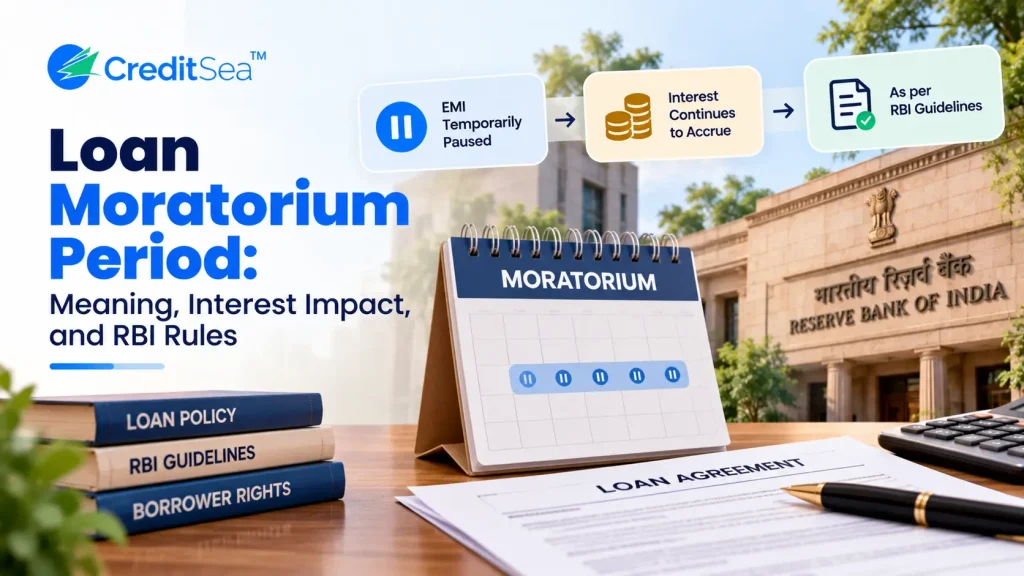
A loan moratorium is an arrangement that helps you to take temporary relief from your scheduled repayment. So a moratorium does not necessarily mean that your loan payments will disappear or the interest will stop accumulating. Depending upon the terms, the interest might still continue to apply, increasing the total amount that you eventually need to repay.
So, if you are someone who has taken a loan, understanding what a loan moratorium period is, its impact on interest, and the applicable RBI rules will help you to make an informed decision before you request your repayment relief.
What Is a Loan Moratorium Period?
A loan moratorium refers to the specific time period in which the lenders allows their borrowers to postpone certain scheduled loan payments. The relief might apply some principal repayment, interest repayment, or both, which depends on the loan arrangement. For example, that you have a personal loan with monthly EMI of 8,000, and there is a specific date for that. So if your lender approves a moratorium that temporarily postpones your EMI, then you might not have to make certain scheduled payment during the time period that has been approved. So you must check what happens to the interest, the outstanding balance, and the repayment schedule.
A moratorium is generally a time period that is temporary, not a waiver of the loan. But the outstanding amount can still be repaid as per the revised terms. You need to understand that the borrower is automatically entitled to a moratorium. Its availability depends on the applicable framework of RBI and the lender’s policies, loan agreement, and certain circumstances under which the relief will be offered.
How Does a Loan Moratorium Work?
And a loan moratorium doesn’t necessarily change the amount of money you owe. It can change if certain payments become due, and the process usually works like this:
- The borrower faces a repayment difficulty. Any unexpected expense, income dispersion, or any other financial challenge can arrive at the borrower, which makes it difficult for him or her to make the payment on time.
- The borrower checks the available relief. They contact the lender to understand if any moratorium or another repayment arrangement is available or not.
- Third, the lender reviews the request. The lender reviews the request and decides whether the borrower and the loan qualify under the applicable terms of the loan moratorium, if it’s possible.
- The repayment schedule is revised. If approved, then the lender will explain which payment can be postponed and for which till which timeline it is possible, and when the repayment will resume.
- The borrower follows the revised schedule. The payments restart according to the approval that has been made.
Note: the exact process for this might vary between the lenders and the loan product. So before you accept the moratorium, ask whether the interest will continue to accrue or whether the loan tenure will increase or not.
What are different types of loan moratoriums?
- Principal repayment moratorium.
The principal repayment according to this term is the arrangement in which the repayment of the principal amount is postponed for a specific timeline, and the borrower might still need to pay interest during that period, depending upon the loan terms. In this type of arrangement, this type of arrangement might be available for certain loans where the borrower needs time before beginning the principal repayment.
- Interest payment moratorium.
An interest payment moratorium helps us to postpone the payment of interest for an approved time period. So postponing your interest payment doesn’t automatically mean that the interest is waived. You need to pay that after some amount of time, and the accumulated interest may become payable later or can be handled according to the agreed repayment terms.
- An EMI moratorium
An EMI means an equated monthly installment, that you need to pay in installment every month. it temporarily will postpone the scheduled EMI, which means the equated monthly installment, subject to the approval arrangement. Since EMI generally includes both principal and interest, the treatment of both components must be clarified well.
For example, a lender might postpone the installment and extend the loan tenure, and another arrangement might change the future installment or will require accumulated dues to be paid later. These are just general explanations, and they do not guarantee a particular type of moratorium is available for every loan. That you need to check in your loan terms and arrangement.
Does your interest stop during this period?
No. Your interest does not stop during a loan moratorium. In many of the arrangements, the interest continues to accrue on the outstanding principal even when the borrower is temporarily not required to make the payments on the scheduled timeline. This distinction is important to understand because the postponed payment can increase your total cost of borrowing. Consider this example: suppose you have an outstanding balance of 2 lakh at the annual interest rate of 12 percent. So if the interest continues to accrue on the entire outstanding balance for the three months, which is your loan moratorium, the approximate simple interest for that period would be.
How a Loan Moratorium Affects Your EMI and Total Interest?
It may offer some immediate cash flow relief but, depending on the revised repayment arrangement, may have a long-term financial impact.
- The monthly EMI impact
Your monthly EMI is the equal monthly installment This is a fixed amount that you have to pay every month but your EMI in this will remain the same, increase or get adjusted as per the changed repayment plan. And, if the lenders increase your loan tenure, then you might have to pay the existing EMI for a longer period of time. Therefore, if the accrued interest is added to the repaid amount, the future installment may also need to be changed.
2. Total interest impact
This interest continues to accrue during the moratorium, so the total amount you owe will be higher. That’s because, in addition to the loan balance, the borrower will also have to make extra payments to cover interest that has accrued during the relief period.
Effect on the period of loan
The lender may also extend the tenor of the loan to accommodate the deferred payments on account of the loan moratorium and spread the repayment over a longer period of time.Or it might be paying interest for a few more months.
What Were the RBI Loan Moratorium Rules?
The RBI introduced a temporary loan moratorium framework during the COVID-19 pandemic just to provide relief to the borrowers who are facing financial problem. And under the RBI circular dated 27 March 2020, the eligible lending institutions were permitted to give a three-month relief on installment for loan terms outstanding as of March 1, 2020. This measure was subsequently extended, with the final extension covering June 1 to August 31, 2020. This framework allowed the eligible lenders to postpone the scheduled payments of their borrowers, but the interest continued to accrue on the outstanding amount portion of loan terms during the moratorium.
Does this mean it will be applied on 2026?
No. The COVID-19 moratorium was a temporary measure that was allowed and that ended in 2020. Now it should not be treated as an ongoing automatic entitlement for the borrowers in today’s world.
Does a Loan Moratorium Affect Your CIBIL Score?
Yes, it doesn’t necessarily guarantee that your CIBIL score will remain unchanged, but its impact depends upon the loan arrangement under which you are in, the lender’s reporting, and how the borrowers handle the repayment.
During the COVID-19 relief period, the RBI issued some specific directions concerning the treatment and the reporting of eligible accounts, and those temporary directions should not be assumed to be applied to every repayment arrangement today.
But if your lender approves a moratorium, ask how the arrangement will be reported to the credit information companies and whether you must continue making any payment during the approved period.
What Should You Check Before Accepting a Loan Moratorium?
A loan moratorium can help you manage a temporary cash flow problem. But before you accept that, you should understand certain things and use this checklist when you are speaking to your lender.
- Interest: Whether your interest will continue to accrue during the moratorium.
- Repayment schedule. Will the repayment tenure increase?
- EMI: EMI amount will be revised in future or not?
- Full repayment. The amount of money remaining to pay back over the rest of the loan term.
- Credit reports. The amount of the approved arrangement you must tell the lender.
- More accusations. Are there any other charges as per agreed terms and conditions?
- Repayment restart date. When will you resume the repayment again after the loan moratorium period is over?
Must Read – Repo Rate and MCLR: How RBI Rate Changes Affect Your Loan EMI
Frequently Asked Questions
What is a moratorium period on a loan?
A moratorium period in a loan is a specific time period in which the lender allows certain scheduled payments to be postponed to provide temporary relief to the borrower. The interest might continue to accrue depending upon the loan terms.
Does interest stop during moratorium?
Not necessarily. You may be charged interest on any unpaid principal. Check the lender’s terms and conditions to see how the accumulated interest will be calculated and how this will affect your repayment.
Does a moratorium affect my CIBIL score?
The impact for that depends upon how the arrangements of the loan are and how the lender reports your account. If your moratorium has been approved, do not confirm that you can miss paying your EMI.
Is there an EMI moratorium in 2026?
The temporary COID-19 moratorium was ended in 2020. Now in 2026, there isn’t any specific automatic scheme. You need to contact your lender and check whether this moratorium option is available to you or not.
Conclusion
A loan moratorium can provide you temporary relief from your difficult paying structure if any unexpected situation comes to you. And it is important to understand that what happens after the relief period ends and interest might continue to accrue, or your future EMIs might change and the loan tenure might increase. But the most important thing to remember is before you accept a moratorium, first review the revised repayment schedule, total interest, and credit reporting implications with your lender. If you are experiencing any repayment difficulty, communicate early with the lender rather than just simply missing your EMIs and making late payments.